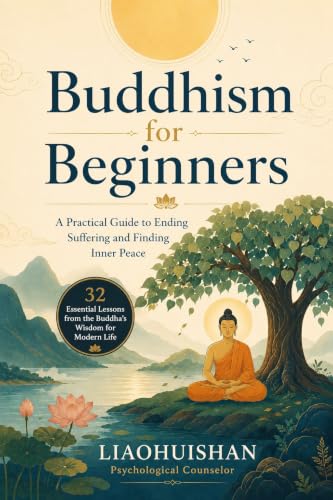
Buddhism for Beginners Book | LiaoHuishan

Buddhism for Beginners book by LiaoHuishan

Book by LiaoHuishan

Buddhism for Beginners

A Practical Guide to Ending Suffering and Finding Inner Peace

A clear 32-lesson path for readers who want to understand why suffering repeats—and how Buddhist wisdom can become a practical way of living.

Read on Amazon →
Language
English
Length
444 pages
Series
Buddha Meets Psychology
ASIN
B0H2F27VD3

About This Book

Insight is valuable, but understanding a pattern does not always free us from it. This book begins at that gap: the place where you know why you feel anxious, attached, or trapped, yet still respond in the same familiar way.

LiaoHuishan presents the Buddha’s core framework in accessible language and connects it with modern emotional life. The emphasis is practical observation and gradual transformation, without requiring religious conversion or prior knowledge of Buddhism.

What You Will Explore

  • The Four Noble Truths as a framework for understanding and ending suffering
  • The Noble Eightfold Path as a practical guide for everyday choices
  • Dependent Origination and how painful cycles are formed
  • Why attachment creates fear, repetition, and emotional dependence
  • Meditation, mindfulness, and a path toward inner freedom

Who This Book Is For

  • Readers beginning their study of Buddhism
  • People facing anxiety, overthinking, or repeated emotional patterns
  • Anyone seeking a structured bridge between Buddhist wisdom and modern psychology

Frequently Asked Questions

Do I need prior knowledge of Buddhism?

No. The book is written as a systematic introduction for modern readers and explains the central ideas in clear language.

Is this a religious conversion book?

No. It invites observation, questioning, and practical application rather than asking the reader to accept beliefs without examination.

What makes the book practical?

Its 32 lessons organize Buddhist teachings around suffering, attachment, daily awareness, and concrete inner transformation.

Continue Reading

Begin with one honest question: what keeps creating suffering in your life?

View the Book on Amazon →

Explore all books  ·  About LiaoHuishan

Popular posts from this blog

Theravada vs Mahayana Buddhism: Key Differences

 Two Paths of Awakening: Liberation from Suffering or Transformation Within the World? Theravada Buddhism and Mahayana Buddhism are the two major traditions that have shaped Buddhist practice across Asia. Although both traditions are rooted in the teachings of the Buddha, they developed different understandings of suffering, liberation, enlightenment, and the purpose of spiritual practice. The simplest way to understand the difference is this: Theravada Buddhism focuses on how human beings liberate themselves from suffering and the cycle of samsara. Mahayana Buddhism focuses on how awakening and Buddha-nature can unfold within this very world. One tradition emphasizes transcendence beyond the cycle of existence. The other emphasizes transformation through wisdom and compassion while remaining engaged with life. However, the deeper question is not which tradition is superior. The deeper question is: What kind of spiritual path truly matches the way we understand suffering, freedom...

Why Did the Buddha Leave His Palace? The Four Sights That Changed Siddhartha's Life

Why Did the Buddha Leave His Palace? The Four Sights That Changed Siddhartha's Life Why did the Buddha leave his palace? The familiar answer is that Prince Siddhartha saw four things his protected life could no longer hide: old age, sickness, death, and a wandering seeker. But the deeper reason was not that he hated his family or rejected ordinary life. He had discovered a question that comfort could not answer: If everything I love can change, weaken, and disappear, is there a way to live without being ruled by fear? This is the story of the Four Sights and the Great Renunciation—not merely as a religious legend, but as a psychological turning point that still speaks to anyone whose carefully arranged life has been interrupted by reality. The Legendary Life of Shakyamuni Buddha Follow Siddhartha from sheltered prince to awakened teacher through a psychologically informed retelling of the Buddha's life. For readers who want the human story behind Bud...

Hinduism vs Buddhism: Why India’s Caste System Endures

Hello everyone, I’m Huishan. Have you ever wondered: Two major religions were born in India, yet Buddhism teaches “equality and liberation,” while Hinduism preserves a system of “caste and reincarnation.” The Buddha taught people to let go of identity and transcend desire; while Hinduism taught people to accept their destiny and submit to social order. Why, after more than two thousand years of tension between these two traditions, did Buddhism eventually retreat from its homeland in India, while Hinduism became even more deeply rooted? Why has the caste system never been completely dismantled? Today, I want to take you deeper into these two seemingly closely related systems and examine just how fundamentally different they really are. Two Spiritual Traditions, Two Different Directions In the 6th century BCE, India gave rise to two enormous spiritual ...