Hinduism vs Buddhism: Why India’s Caste System Endures
Hello everyone, I’m Liao Huishan.
Have you ever wondered:
Two major religions were born in India, yet Buddhism teaches “equality and liberation,” while Hinduism preserves a system of “caste and reincarnation.”
The Buddha taught people to let go of identity and transcend desire;
while Hinduism taught people to accept their destiny and submit to social order.
Why, after more than two thousand years of tension between these two traditions, did Buddhism eventually retreat from its homeland in India, while Hinduism became even more deeply rooted?
Why has the caste system never been completely dismantled?
Today, I want to take you deeper into these two seemingly closely related systems and examine just how fundamentally different they really are.
Two Spiritual Traditions, Two Different Directions
In the 6th century BCE, India gave rise to two enormous spiritual traditions:
one was Hinduism, a system that maintained social order;
the other was Buddhism, which opposed hierarchical oppression.
The founder of Buddhism, Siddhartha Gautama — later known as Shakyamuni Buddha — was himself born into the Kshatriya caste, the warrior and ruling class within the Indian social system.
He saw Brahmin priests controlling religious authority while people at the bottom of society suffered oppression. He therefore gave up his royal life, became an ascetic, and eventually attained enlightenment.
His conclusion was revolutionary:Human suffering does not come from caste or destiny.It comes from attachment.Let go of attachment, and you can transcend samsara.Everyone has the possibility of awakening, regardless of birth, wealth, or caste.

This challenged one of the most fundamental structures of Hindu society.
Yet ironically, Buddhism flourished in India for only several centuries before later thriving across China, Japan, and Southeast Asia;
while Hinduism and the caste system survived in India into the modern era.
Why?The answer begins with one fundamental difference:
Their answers to the question “Who am I?” are completely different.
| Dimension | Hinduism | Buddhism |
|---|---|---|
| View of the Universe | Everything emerges from Brahman, and all beings are part of Brahman. | All phenomena are impermanent, and there is no permanent self. |
| Individual Existence | There is an Atman, an eternal Self or soul. | There is no permanent self; the individual is only a temporary aggregation of the Five Aggregates. |
| Meaning of Life | Fulfill one’s caste duties and ultimately reunite with Brahman. | Break attachment, awaken to reality, and ultimately escape samsara. |
| Social Structure | Castes are differentiated, each performing its own role; rebirth is connected to actions in previous lives. | All beings are fundamentally equal in the path of practice; monastic life is not determined by birth. |
Shiva and Buddha: Two Forms of Transformation
There is also an interesting mirror relationship between Shiva and the Buddha.
One is the Hindu god of destruction;
the other is the awakened one who teaches letting go.
Both withdraw from ordinary society and are associated with silence and transcendence. Both inspire awe, yet remain difficult for ordinary people to fully understand.
One holds a trident and dances through cosmic fire;
the other sits beneath the Bodhi tree and awakens in silence.
One moves, the other remains still.
One burns, the other dissolves.
Yet both point toward the dissolution of the ordinary ego.
From a psychological and philosophical perspective, we can view them as representing two different forms of consciousness transformation:
| Dimension | Shiva | Buddha |
|---|---|---|
| Symbolic Archetype | Master of the shadow, righteous destroyer, cosmic dancer. | Wise observer, deconstructor of desire, embodiment of emptiness. |
| Mode of Action | Destroys and renews the cosmic cycle. | Transcends samsara and releases attachment. |
| Spiritual Path | Transcends desire through fire, destruction, and asceticism. | Sees through the illusion of the self through observation and the Middle Way. |
| Representative Energy | Active Transformation | Passive Dissolution |
| Attitude Toward the Self | Destroy the ego so that divinity can reveal itself. | See through the ego as an illusion and stop identifying with it. |
| Relationship with Social Structure | Guards a spiritual gateway within cosmic order. | Renounces social roles and rejects hierarchy in spiritual practice. |
The difference is that the former tells you to accept destiny and submit to divine order;
the latter tells you to awaken and question everything.
And precisely because of this, Buddhism came to be regarded by sections of India’s priestly and upper classes as a “dangerous idea.”
It challenged the legitimacy of existing interests.
Later, as India experienced warfare and social instability, people’s desire for order increased again.
Hinduism, strengthened through political and cultural revival, gradually regained dominance while Buddhism declined in India.So Why Has the Caste System Survived Until Today?
In my view, the caste system is not merely a religious issue.
It is also deeply rooted in several psychological tendencies within human beings.
1. Identity Anxiety
When life feels uncontrollable, people naturally look for a stable identity.
Caste provides the illusion of that stability.
It tells you:“You only need to fulfill the duties of the position into which you were born, and reincarnation will eventually reward you.”
2. Structural “Psychological Laziness”
Hinduism does not necessarily encourage people to question “Who am I?” Instead, it can reinforce the idea that “you are the person assigned to this position within the caste system.”
Religion, morality, destiny, society, and the gods are therefore tied into a single structure. Once people stop questioning that structure, oppression itself can begin to appear legitimate.
3. The Oppressors Also Believe They Represent “Order”
The most ironic part is that the Brahmins and elites who defended the caste system could also believe that they were protecting the order and peace of the world.
Because from within their worldview:
if hierarchy disappeared, society itself might descend into chaos.Freedom, Identity, and the Psychological Power of the Cage
In short,the caste system has survived for thousands of years not because it is just, but because it tells people where they are supposed to stand in the real world.
And Buddhism lost its ground in India not necessarily because it lacked truth.
It was because Buddhism does not give people a fixed social role to perform.
Human beings do desire freedom.But when confronted with chaos,
they often desire an answer to the question “Who am I?” even more.
Freedom may be an endless sky.
But many people would rather choose a cage,
because a cage has a name, boundaries, an address, and an identity recognized by other people.
It is not free, but it is familiar.
It may not be comfortable, but it feels safe.
It may not be a truly self-defined life, yet it becomes the destination of most people.
Perhaps compared with the uncertainty that freedom brings, people would rather remain inside a cage woven from rules.
What is truly frightening may not even be oppression itself.
It may be the freedom that forces you to define the meaning of your own life.
So, in other words,the reason India’s caste system has survived for thousands of years is not simply because the system itself is powerful.
It survives because it solves one of the most difficult psychological problems for human beings:
how to live with meaning, while knowing which social role one is supposed to play.
If you would like to broaden your perspective further, you are welcome to read my book.
Why Did I Find Nothing When I Went to Nepal in Search of the Buddha?Read the Book on Amazon
I am Liao Huishan, and I hope this piece has given you some inspiration.
More on the Buddha's Life and Teachings
- Was the Buddha Hindu? A More Accurate Historical Answer
- Was the Buddha a God? What Buddhism Really Teaches
- Did the Buddha Really Exist? What Historians Can Say
- Buddhism in South, Central & Southeast Asia: Key Differences
- Why Buddha Stayed Silent: Four Noble Truths Explained
滑动购买更多作品 →
Browse bestsellers on Amazon — tap a cover to open the book page. Full author store: B0H2T1BBYC.
 Legendary Life of Shakyamuni
Buy on Amazon
Legendary Life of Shakyamuni
Buy on Amazon
 Eight Sufferings of the Buddha
Buy on Amazon
Eight Sufferings of the Buddha
Buy on Amazon
 Diamond Sutra Psychology
Buy on Amazon
Diamond Sutra Psychology
Buy on Amazon
 Heart Sutra Psychology
Buy on Amazon
Heart Sutra Psychology
Buy on Amazon
 Dhammapada Psychology
Buy on Amazon
Dhammapada Psychology
Buy on Amazon
 Buddhism for Beginners
Buy on Amazon
Buddhism for Beginners
Buy on Amazon
 Healing Family Wounds
Buy on Amazon
Healing Family Wounds
Buy on Amazon
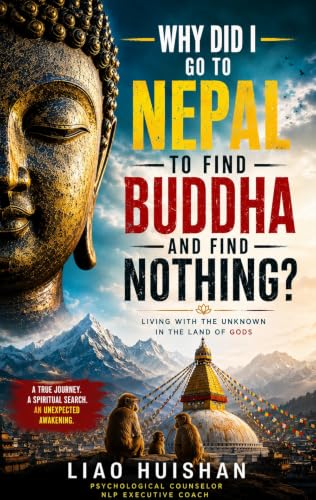 Searching for the Buddha in Nepal
Buy on Amazon
Searching for the Buddha in Nepal
Buy on Amazon
 Psychology of the I Ching
Buy on Amazon
Psychology of the I Ching
Buy on Amazon
 Uninstall Your Pain
Buy on Amazon
Uninstall Your Pain
Buy on Amazon