The Heart Sutra in Plain English: Emptiness and Freedom from Fear
珊
In plain English, the Heart Sutra teaches that the five aggregates—form, feeling, perception, mental formations, and consciousness—are empty: they have no independent, fixed nature and arise from causes and conditions. Emptiness does not mean that nothing exists. Seeing this clearly, the mind is free from obstruction, and because there is no obstruction, there is no fear.
When Avalokiteśvara Bodhisattva was practicing deeply the Prajñāpāramitā—the Perfection of Wisdom—Avalokiteśvara looked deeply and saw that the five aggregates that make up our experience of body and mind—form, feeling, perception, mental formations, and consciousness—are all empty of any independent, fixed, or inherent nature.
Through clearly seeing the emptiness of the five aggregates, Avalokiteśvara transcended all suffering and distress.
The same is true of feeling, perception, mental formations, and consciousness.
Form refers to the body and material phenomena.
Feeling refers to the pleasant, unpleasant, and neutral tones of experience that arise in our encounters with the world.
Perception is the process by which we recognize, identify, and form mental representations of what we experience.
Mental formations include volition, intention, conditioning, and the many mental activities that shape and propel our responses.
Consciousness is the knowing of an object that arises in dependence upon a sense faculty and its corresponding object.
What, then, does emptiness mean?
Emptiness does not mean that nothing exists.
It means that phenomena do not possess an independent, permanent, self-sufficient nature. They arise in dependence upon causes and conditions, and they change as those causes and conditions change.
They neither inherently arise nor cease; they are neither inherently impure nor inherently pure; they neither inherently increase nor decrease.
Therefore, within emptiness, form cannot be grasped as possessing an independent and fixed nature. The same is true of feeling, perception, mental formations, and consciousness.
The six sense faculties—eye, ear, nose, tongue, body, and mind—have no fixed, independent nature.
The six corresponding sense objects—form, sound, smell, taste, touch, and mental objects—likewise have no fixed, independent nature.
The six consciousnesses that arise in dependence upon the sense faculties and their corresponding objects—from eye-consciousness through mind-consciousness—are likewise empty of fixed, independent nature.
Thus, from the realm of the eye through the realm of mind-consciousness, none of the eighteen elements can ultimately be grasped as an independent, permanent entity.
The same is true of ignorance.
Ignorance has no fixed, independent nature, and neither can the cessation of ignorance be grasped as an independently existing entity.
The same applies all the way through aging and death and the cessation of aging and death. Every link in the twelve links of dependent origination is likewise empty of fixed, independent nature.
The Four Noble Truths—suffering, the origin of suffering, the cessation of suffering, and the path leading to the cessation of suffering—likewise cannot ultimately be grasped as independently existing entities with fixed nature.
This does not deny wisdom itself. Rather, even wisdom and attainment cannot ultimately be grasped as possessions belonging to a separate, independent self.
Ultimately, there is nothing that can be grasped and claimed: “This is what I have attained.”
Because there is nothing to attain, the bodhisattva relies upon the Prajñāpāramitā, and the mind is free from obstruction.
Because the mind is free from obstruction, there is no fear.
Having gone beyond distorted perceptions and delusive thinking, one reaches ultimate nirvāṇa.
All Buddhas of the past, present, and future likewise rely upon the Prajñāpāramitā and thereby realize unsurpassed, complete awakening.
Therefore, know that the Prajñāpāramitā is the great mantra, the mantra of great illumination, the unsurpassed mantra, the unequalled mantra.
It is said to dispel all suffering; it is true, not false.
Therefore, the mantra of the Perfection of Wisdom is proclaimed:
gone beyond,
gone completely beyond—
awakening, svāhā.
A Modern Psychological Reading
If you have read this far, you may have noticed that the real challenge of the Heart Sutra is not simply reciting its roughly 260 Chinese characters.
The deeper challenge is understanding what emptiness, the five aggregates, non-attainment, and a mind free from obstruction have to do with the way we actually live.
This question lies at the heart of my book, Heart Sutra Psychology.
I did not want to write a book that merely explains Buddhist terminology. Nor did I want to place modern psychology beside an ancient Buddhist text and force the two together.
Instead, I wanted to follow the path of inquiry already present within the Heart Sutra and explore a deeply practical question:
And when we begin to see our feelings, thoughts, attachments, and fears more clearly, how does change become possible?
In Heart Sutra Psychology, I begin with the central teachings of the five aggregates, emptiness, non-attainment, and the unobstructed mind.
I then draw carefully on modern psychological perspectives concerning cognition, emotion, attachment, self-identity, and psychological flexibility to explore how this ancient wisdom can illuminate the realities of contemporary life.
Read next
- Heart Sutra Meaning for Anxiety and Fear: An Answer-First Guide
- Heart Sutra Meaning: Why Attachment Creates Fear & How to Let Go
- The Diamond Sutra: A Complete Modern Translation by Liao Huishan
Continue Reading
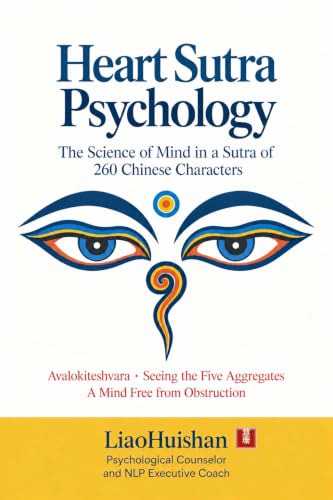
Heart Sutra Psychology
Beginning with the insight of “seeing that the five aggregates are empty,” this book explores thought, attachment, fear, and inner freedom—and how the ancient wisdom of the Heart Sutra can illuminate the psychological struggles of modern life.
View on Amazon →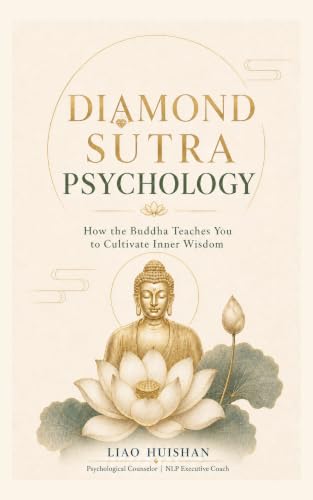
Diamond Sutra Psychology
Beginning with the teaching “let the mind arise without abiding anywhere,” this book explores why we continually cling to relationships, judgments, identities, and outcomes—and what it might mean to live without being governed by that grasping.
View on Amazon →The Heart Sutra teaches us to see clearly.
The Diamond Sutra trains us not to abide.
One turns inward to illuminate how attachment takes shape in the mind. The other asks how we might live in the world without continually being carried away by what we grasp.
If you are living with anxiety, overthinking, difficulty letting go of a relationship, or simply wondering why the wisdom of Prajñāpāramitā still matters more than two thousand years later, either book can be a place to continue.