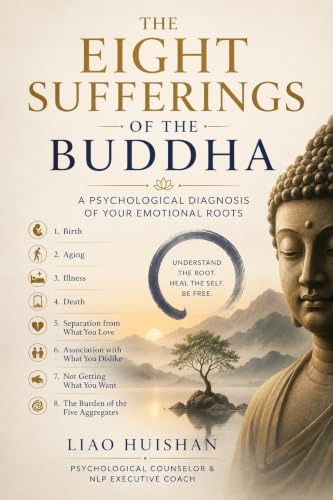
The Eight Sufferings of the Buddha | LiaoHuishan

Book by LiaoHuishan

The Eight Sufferings of the Buddha: A Psychological Diagnosis of Your Emotional Roots

A diagnostic map for naming recurring emotional pain and meeting it through Buddhist wisdom, psychological reflection, and practical exercises.

Read or buy the Kindle edition on Amazon →
Language
English
Format
Kindle eBook
Length
281 pages
Published
June 18, 2026
Series
Buddha Meets Psychology
ASIN
B0H5XQ82FN

Book overview

Sometimes people collect tools without understanding the pattern that keeps producing their pain. This book uses the Buddha's Eight Sufferings as a map for examining anxiety, attachment, separation, unmet desire, identity, aging, illness, and death.

Each form of suffering is approached from two directions: the Buddhist question of how clinging creates distress, and the psychological question of what can be practiced now. The result is a structured companion for readers who want insight, self-assessment, and concrete exercises.

What you'll learn

  • How the Eight Sufferings function as an emotional diagnostic map
  • How attachment, resistance, and impermanence interact in everyday pain
  • How to use an 80-question self-assessment to notice recurring patterns
  • How eight case studies connect Buddhist ideas with contemporary emotional life
  • How more than 40 exercises support awareness, boundaries, reflection, and change

Who this book is for

  • People who feel recurring emotional pain but cannot yet name its pattern
  • Readers facing anxiety, burnout, attachment, or emotional exhaustion
  • Anyone exploring relationship loss, identity change, aging, illness, or existential fear

Core concepts

The Eight Sufferings name recurring dimensions of human vulnerability: birth, aging, illness, death, separation from what we love, contact with what we dislike, not getting what we want, and the instability of embodied identity.

Clinging and resistance explain why unavoidable change can become prolonged psychological distress. The book does not ask readers to suppress emotion; it asks them to see what the mind is trying to hold still.

Impermanence and practical reflection connect Buddhist insight with observable emotional habits, so a classical teaching becomes a usable map rather than an abstract doctrine.

About the author

LiaoHuishan (廖慧珊) writes where Buddhist wisdom and modern psychological reflection meet. Her books translate classical maps of suffering into clear questions and grounded practices for contemporary emotional life.

Frequently asked questions

What are the Eight Sufferings?

They are a Buddhist framework for understanding recurring forms of human pain, including aging, illness, death, separation, unwanted contact, unmet desire, and the instability of embodied identity.

Is this book also a workbook?

It contains an 80-question assessment, case studies, and more than 40 practical exercises for reflection and change.

Do I need to be Buddhist?

No. The framework is explained for general readers and placed in dialogue with modern psychological ideas and practices.

Read or buy

Name the pattern beneath the pain, then begin changing your relationship with it.

View The Eight Sufferings on Amazon →

Explore all books by LiaoHuishan  ·  About LiaoHuishan

Popular posts from this blog

Theravada vs Mahayana Buddhism: Key Differences

 Two Paths of Awakening: Liberation from Suffering or Transformation Within the World? Theravada Buddhism and Mahayana Buddhism are the two major traditions that have shaped Buddhist practice across Asia. Although both traditions are rooted in the teachings of the Buddha, they developed different understandings of suffering, liberation, enlightenment, and the purpose of spiritual practice. The simplest way to understand the difference is this: Theravada Buddhism focuses on how human beings liberate themselves from suffering and the cycle of samsara. Mahayana Buddhism focuses on how awakening and Buddha-nature can unfold within this very world. One tradition emphasizes transcendence beyond the cycle of existence. The other emphasizes transformation through wisdom and compassion while remaining engaged with life. However, the deeper question is not which tradition is superior. The deeper question is: What kind of spiritual path truly matches the way we understand suffering, freedom...

Why Did the Buddha Leave His Palace? The Four Sights That Changed Siddhartha's Life

Why Did the Buddha Leave His Palace? The Four Sights That Changed Siddhartha's Life Why did the Buddha leave his palace? The familiar answer is that Prince Siddhartha saw four things his protected life could no longer hide: old age, sickness, death, and a wandering seeker. But the deeper reason was not that he hated his family or rejected ordinary life. He had discovered a question that comfort could not answer: If everything I love can change, weaken, and disappear, is there a way to live without being ruled by fear? This is the story of the Four Sights and the Great Renunciation—not merely as a religious legend, but as a psychological turning point that still speaks to anyone whose carefully arranged life has been interrupted by reality. The Legendary Life of Shakyamuni Buddha Follow Siddhartha from sheltered prince to awakened teacher through a psychologically informed retelling of the Buddha's life. For readers who want the human story behind Bud...

Hinduism vs Buddhism: Why India’s Caste System Endures

Hello everyone, I’m Huishan. Have you ever wondered: Two major religions were born in India, yet Buddhism teaches “equality and liberation,” while Hinduism preserves a system of “caste and reincarnation.” The Buddha taught people to let go of identity and transcend desire; while Hinduism taught people to accept their destiny and submit to social order. Why, after more than two thousand years of tension between these two traditions, did Buddhism eventually retreat from its homeland in India, while Hinduism became even more deeply rooted? Why has the caste system never been completely dismantled? Today, I want to take you deeper into these two seemingly closely related systems and examine just how fundamentally different they really are. Two Spiritual Traditions, Two Different Directions In the 6th century BCE, India gave rise to two enormous spiritual ...